
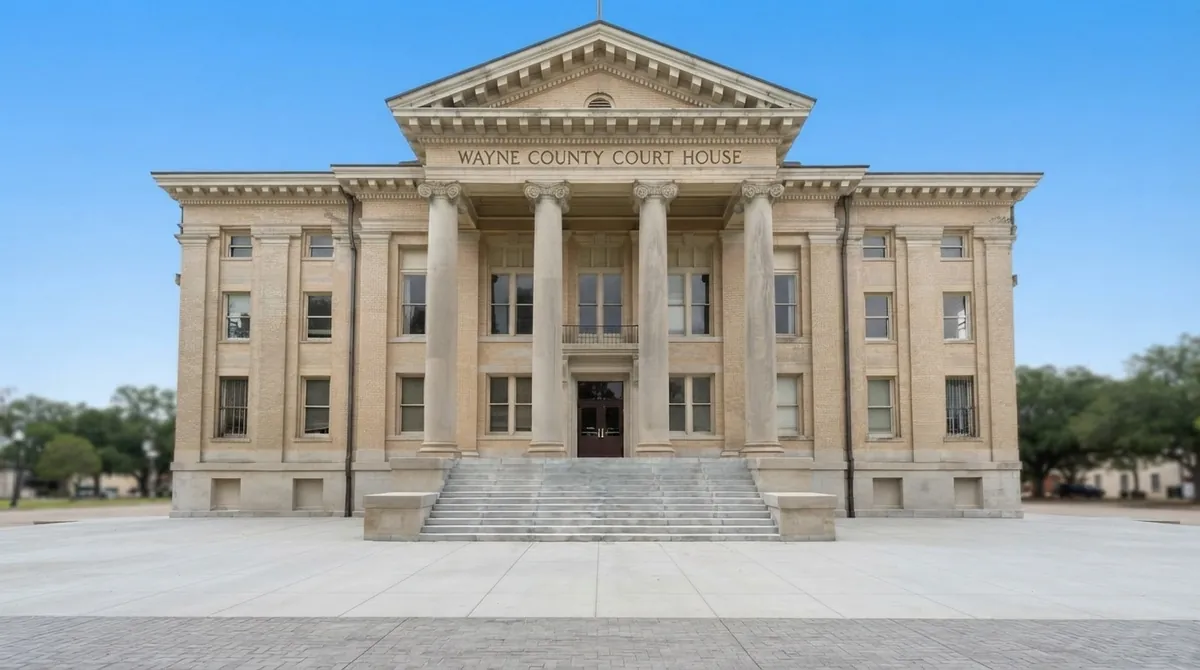
Court records of Wayne County, North Carolina, are maintained by the Clerk of the District Court and are accessible through the Clerk's office, official state judicial portals, and online tools. WayneCourt.us allows for quick access to public information about court cases in this county. Additional resources include the Wayne County page on the NC Judicial Branch portal, instructions for obtaining court records, and an in-person visit to the courthouse in Goldsboro.
Wayne Court System Overview
Wayne County is part of the 8th Judicial District of North Carolina. This judicial district exclusively covers Wayne County. The general jurisdiction courts in the county are divided into two tiers: the Superior Court, which handles serious criminal cases and large civil claims, and the District Court, which deals with less serious cases, family law, and small claims. Magistrates are judicial officers working under the Chief District Court Judge and perform limited functions: issuing warrants, setting bail, and hearing small civil disputes.
The Wayne County Courthouse is located at:
Contact information for individual court departments can be found in the Wayne County contact directory.
Courts Serving Wayne
Residents of Wayne County are served by several judicial bodies at both the state and federal levels.
State Courts
For phone numbers of specific departments, refer to the official contact directory.
Federal Courts
What Types of Cases Wayne Courts Hear
Wayne County courts hear a wide range of cases distributed among the Superior Court, District Court, and magistrates:
- Felonies — Superior Court
- Misdemeanors — District Court
- Traffic violations and infractions
- Civil claims of various scales
- Small claims
- Family law: divorce, custody, alimony, paternity
- Probate and wills
- Guardianship and conservatorship
- Juvenile cases and child protection
- Adoptions
- DWI cases (driving while impaired)
Each category is discussed in more detail in the following sections.
District Court Cases in Wayne
The District Court in Wayne County is the workhorse of the local judicial system. It handles misdemeanors, traffic violations, DWI cases, and all family matters: divorce, child custody, alimony, protective orders. Civil claims up to $25,000 also fall here. Additionally, the District Court hears appeals from magistrate decisions in small claims.
Cases are assigned to district judges on a rotating basis. Criminal cases begin with the defendant's first appearance before a judge, followed by pre-trial motions, plea negotiations, or trial. In civil cases, the judge conducts a preliminary conference, sets a schedule, and, if necessary, appoints mediation.
Magistrate Court Cases in Wayne
Wayne County magistrates perform several key functions, although their jurisdiction is narrower than that of the District Court. They issue arrest and search warrants, conduct initial appearances, set bail, and administer oaths.
In the civil sphere, magistrates hear small claims cases up to $10,000 according to North Carolina law. A magistrate's decision can be appealed to the District Court, where the case will be heard anew (trial de novo). Magistrates can also handle certain eviction and debt collection cases within the set limit. Their office operates 24/7 to accept complaints and issue warrants.
Family Law, Probate, and Juvenile Matters in Wayne
Family Law
Divorce, custody, alimony, paternity, and protective orders from domestic violence are handled by the District Court. Divorce certificates can be obtained from the Clerk of Court's office where the case was filed or through NC Vital Records. To file for divorce, one spouse must have resided in North Carolina for at least six months.
Probate
The Clerk of Superior Court in Wayne County acts as the probate judge. They approve wills, appoint executors and administrators, and oversee the distribution of deceased estates. Guardianship and conservatorship cases for incapacitated individuals are also handled by the clerk. To order birth or death certificates, contact NC Vital Records.
Juvenile Matters
The District Court hears juvenile delinquency cases and child protection cases (Child Protective Services). Juvenile records are confidential under state law. The Wayne County Department of Social Services participates in cases involving child protection.
How Cases Move Through the Wayne Court System
- Case Initiation. A criminal case begins with a complaint or warrant. A civil lawsuit starts with filing a complaint with the Clerk's office. Family and probate cases begin with the appropriate petition.
- Initial Appearance / Judge Assignment. In criminal cases, the defendant appears before a magistrate or District Court judge for bail setting. Civil cases are assigned to judges.
- Pre-trial Phase. Parties exchange evidence (discovery), file motions. In criminal cases, plea negotiations may occur.
- Trial or Settlement. The case concludes with a verdict, settlement, default judgment, or dismissal.
- Post-judgment. The convicted receives a sentence. Parties may appeal: from District Court to Superior Court, from Superior Court to Court of Appeals.
The duration of the process depends on the complexity of the case. A small claim in magistrate court may be resolved in a few weeks, while a complex criminal case in Superior Court may take months.
Court Administration, Local Rules, and Public Access in Wayne
Administrative control over the county courts is exercised by the Chief District Court Judge of the 8th Judicial District along with the court administrator. Local court rules and session schedules are published on the Wayne County page on the NC Judicial Branch portal.
Under North Carolina law, most court records are public. Anyone can visit the Clerk's office to view paper case materials or order copies. Some categories of records have restricted access:
- Juvenile cases — confidential
- Adoption cases — sealed
- Records containing social security numbers or parties' financial information may be partially closed
Court sessions are generally open to the public. For information on remote participation in hearings, contact the Clerk's office. Clerk Whitfield requests visitors to arrive at the office early to ensure they are served before closing at 5:00 PM.
Court Records and Related Court Resources in Wayne
- Online Case Search. The NC Judicial Branch portal allows searching for court records, session dates, and making payments.
- Obtaining Copies of Court Records. Paper case materials are available at the Clerk of Court's office in the county where the case is registered. Fees apply for copies.
- Criminal History and Conviction Checks. The Court Records page on the NC Judicial Branch portal explains how to conduct a conviction check and apply for expungement.
- State Prison Inmate Search. The Offender Search by the NC Department of Adult Correction provides current information on inmates serving sentences or on probation.
- Public Records of the Department of Corrections. Public records online contain historical data since 1972 but do not include information from county jails.
- County Jail Inmate Search. The Inmate Inquiry on the Wayne County Sheriff's website allows checking if a person is in local detention.
- Birth, Death, Marriage Certificates. Order through NC Vital Records — these are not free public documents.
- Forms and Self-Help Resources. The NC Judicial Branch portal offers court forms, instructions for self-represented individuals, and information on legal aid.